JustGardenCentres.com


 OTHER PEA PAGES
The good news (there is no bad news!) concerning caring for pea plants in the UK is they have only two real needs after they start growing. Their primary need is for moisture in the soil. Peas love moisture at their roots. They don't need to be water logged but it's best to keep the soil slightly more moist compared to most other vegetables.
Pea plants are slightly unusual compared to most (although not all) plants because they are able to "fix" usable nitrogen from the air and they then store that nitrogen in small nodules (visible to the naked eye) formed on the roots which appear as little rounded bumps. The nitrogen in these nodules is then used by the pea plant as and when required.
So, feeding pea plants with a feed high in nitrogen is a waste of time. It will only encourage leaves atthe expense of peas, and it will simply get wasted.
Average soils in the UK will normally provide all the nutrients pea plants need although blood, fish and bone long lasting fertiliser sprinkled on the surrounding soil at the rate of a handful per square metre every month can often be beneficial
The other key need of peas is support. This varies considerably between varieties. Climbing peas such as Alderman / Victorian Colossal definitely need a support structure which they can grow up. Dwarf varieties of peas require some minimal support but often twigs are sufficient.
The majority of UK gardeners who grow peas choose dwarf varieties of pea - a dwarf pea variety can be considered as a variety which reaches a mature height of 1 metre or less. Excellent and popular varieties which fall into this category include Avola, Hurst Green Shaft and Kelvedon Wonder.
The best and cheapest supports for dwarf peas are prunings from woody plants with sturdy but narrow twigs. Personally we still use prunings from raspberry bushes, blackcurrant bushes are also a good choice. Forsythia bushes will also provide lots of suitable twigs.
In most cases you wont need to tie the plants into the twigs, the plants will naturally grow into any nearby support. A little encouragement to point the pea plants in the right direction will help.
Most climbing pea plants will easily reach a height of 2m and beyond if they have a structure to support them. However, being realistic, aim for an eventual height of around 1.8m. There are two key reasons for this.
Firstly, there is no point in growing climbing peas to a height beyond your ability to reach the top of them for harvesting. Secondly, the higher the pea plants grow, the stronger the support will need to be.
For climbing peas you will need bamboo or similar canes. You will also need "pea netting" which is available online and at garden centres. The netting (and the canes) can last for several years. You will also need ties to tie the plants to the canes.
Our preferred arrangement of the canes is an inverted V shape with the canes set into the soil and tied together at the top. This gives the supports far more stability compared to a single row of canes.
When the climbing pea plants reach to about 15cm / 6in from the top of the canes pinch out the growing tips of the pea plants. This will stop them growing higher and also encourage them to start producing peas lower down. If you let them grow taller they will simply flop over the top of the supports.
The following paragraphs give you a good idea of when you can expect to be harvesting peas in your area of the UK
Pea plants take between 12 weeks to 16 weeks from planting to harvest depending on the variety. Mangetout pea varieties can be harvested slightly earlier, around 10 weeks if you prefer them to be really tender.
As far as reaching maturity and harvesting is concerned, pea varieties are classified as first early, second early or maincrop.
First Early - these are ready to start harvesting 12 weeks after sowing outdoors, which is the first week of June in average areas of the UK.
Second Early - these are ready to start harvesting 14 weeks after sowing outdoors, which is the third week of June in average areas of the UK.
Maincrop - these are ready to start harvesting 15 weeks after sowing outdoors, which is the third week of July in average areas of the UK.
Not frequently grown by gardeners in the UK, old fashioned Marrowfat peas take around five months to reach maturity.
There are several benefits to continuously harvesting peas. Firstly, young peas taste far better than older ones. Secondly, frequent harvesting will help prevent the plants from collapsing under the weight of the growing pods. The final advantage is that the pea plants will produce more peas - it's a win, win situation.
Pea plants are self-pollinating in almost all cases. Occasionally natural cross pollination can occur where different varieties are planted very close to each other but this is not likely.
The relevance of this is that peas saved in one year (if stored correctly) can be planted the next and subsequent years and they will produce pea plants exactly the same as the parent plant. The process is simple, very reliable and costs nothing so give it a try.
When it comes time to harvest your peas, leave two or three plants undisturbed. Over the next month or so the pods will gradually turn a light brown colour, leave the pods on the plant for another month. There is no hard and fast rule as to when the pea seeds are ready for storage. Certainly if you pick a pod, shake it and you can hear the peas rattle inside then they are ready for storage.
But this can often be misleading. Some pea pods simply don't dry out in a manner which allows the peas inside to become free inside the pod to give that classic pea rattle!
So I suggest that two months after you have harvested your other peas for eating, the remaining peas will have dried out sufficiently to be ready for storage. Pick one pod, open it up and the peas should look like those below.
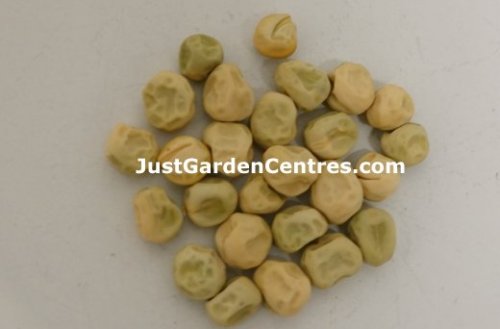

Peas ready for storage and replanting
Keeping the peas dry (the ripened pods will protect them to a great degree) is essential if they are to be stored successfully for next year. So here's the checklist I use in my head to decide when to pick the peas for storage until next year.
1. Wait two months after harvesting your main crop of peas.
2. Have the pea pods turned light brown and feel crunchy when held lightly?
3. Pick one pod and examine it. Do the peas look wrinkled and hard?
4. Are weather conditions dry?
If the above conditions are satisfied, it's time to pick your ripened pods.
As far as storage is concerned I suggest that it's best to store your pea seeds as the seed companies do - in a small paper bag. I always use envelopes and never use plastic bags. Paper envelopes allow the contents to breathe slightly, plastic bags will simply trap in any remaining moisture. Store the envelope in a cool, dry and dark place.
OTHER PEA PAGES
IF YOU HAVE ANY QUESTIONS OR COMMENTS
CONCERNING THIS PAGE, ENTER THEM BELOW.
WE WILL ANSWER ON
THIS PAGE AS SOON AS POSSIBLE
Copyright 2025 - 2026 JustGardenCentres.com. All rights reserved