JustGardenCentres.com


 OTHER BROAD BEAN PAGES
Very late winter or early spring is the most popular time of the year to sow broad bean seeds. If you sow them initially under cover / inside there are some advantages but also disadvantages.
The advantages are that seeds sown under cover / inside will start into growth earlier than those sown outside. This can definitely result in an earlier crop of broad beans. It also significantly reduces the chances of the seeds or emerging seedlings being damaged by pests.
The disadvantages are primarily that sowing the seeds indoors / under cover requires room for storing the pots as the seeds germinate and grow. This may or may not be a problem for you depending on how many broad bean plants you want to grow and how much space you have.
Broad bean seedlings do not take up too much space, see the picture below with a teaspoon nearby for comparison purposes.
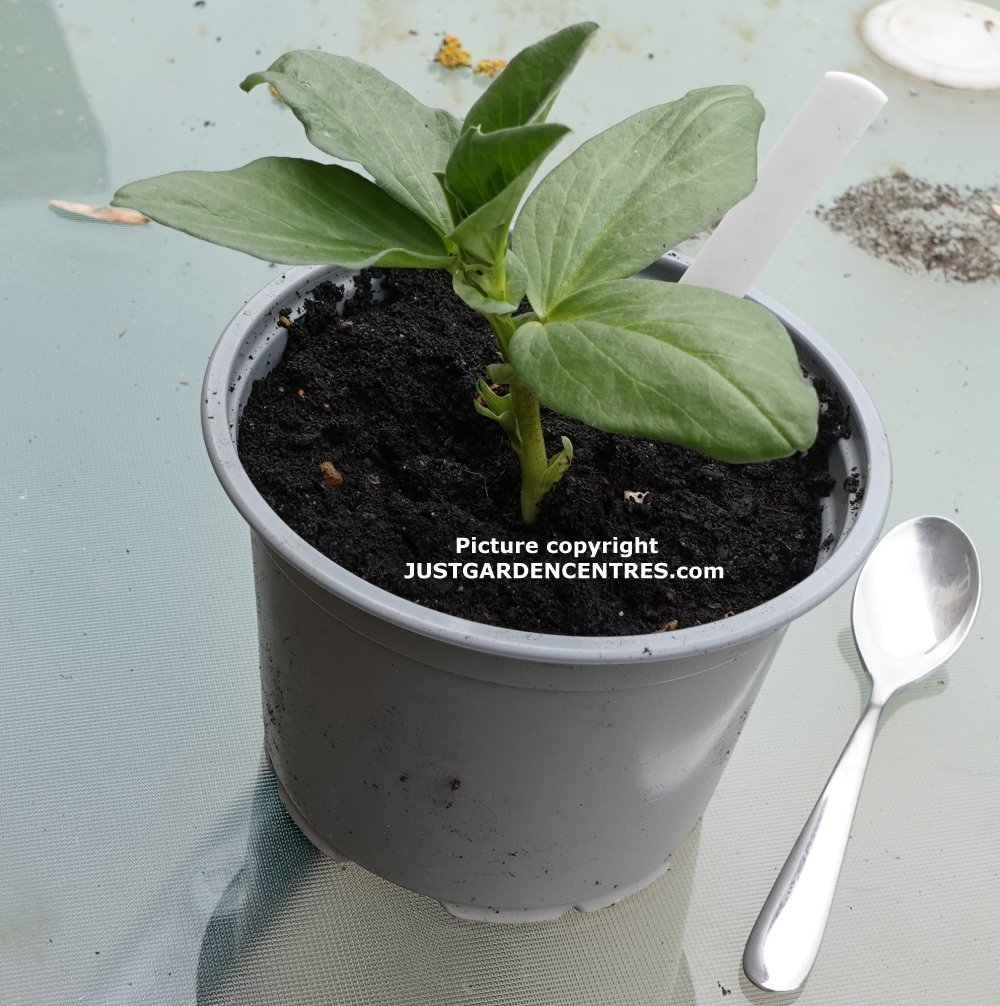

Seedling ready for planting outside
The second disadvantage is that you will need to pot the plants up once into larger pots. This takes time and requires a supply of compost.
The best time to sow broad bean seeds under cover / inside in late winter / early spring is in the last week of February in average areas of the UK.
The best time to sow broad bean seeds outside in early spring is in the first week of March in average areas of the UK.
STEP 1
Fill 7.5cm / 3in pots to just below the top with good quality multi-purpose peat free compost - one pot for each plant to be grown plus an extra two in case not all the seeds germinate.
Gently firm down the compost and place the pots in a shallow container of water. Leave the pots in the water for 30 minutes or so to let the compost absorb the water and is slightly damp on the compost surface.
Take the pots out of the water and let any excess water drain away for another 30 minutes.
Place one seed on the compost in the centre of each pot and gently firm it into the surface of the compost.
insert picture here of seeds on top of compost
STEP 2
Sprinkle a thin layer of compost over the seeds - just enough to cover them. You can, instead, sprinkle a thin layer of vermiculite over the seeds if you have some. But, compost or vermiculite, they both do the same job.
Label each pot with the name of the seeds and the date sown.
insert picture here of covered seeds with label
STEP 3
Possibly the most important part of raising sweet pepper plants from seed is where they are placed after you have set up the seeds in the pots.
Sweet pepper seeds need a minimum temperature of 18°C / 65°F to germinate and will germinate even quicker at several degrees higher. A warm windowsill in most houses is ideal.
Expect the seedlings to emerge between 7 to 21 days later. If the seedlings haven't emerged after 25 days it's safe to say that they have failed to germinate.
insert picture here of newly emerged seedlings
STEP 4
Sweet pepper seedlings need warmth to grow well so grow them on at 18°C / 65°F or slightly above until they are ready to be hardened off (see step 5).
Keep the soil moist but not water-logged. Feeding your sweet pepper plant should not be required until you start to harden off your plants (see step 5 for details) because sufficient nutrients will be in the compost for six weeks of growth.
About five weeks after sowing your sweet pepper seeds ( the first week of May in average areas of the UK) they will benefit from being potted up into larger pots, about 15cm / 6in in diameter.
STEP 5
Prior to placing your plants outside permanently (or in a greenhouse) they need to become acclimatised to outside conditions, this process is called hardening off. The best time to start the hardening off process is the third week of May in average areas of the UK.
This will take a couple of weeks and you need to protect them (or temporarily bring them indoors) if harsh conditions look likely.
At the start of the hardening off process, start to feed the plants with a liquid, general purpose fertiliser once a week. This type of feed will be relatively high in nitrogen which will encourage the foliage of the plants to grow.
STEP 6
We strongly suggest that sweet peppers are grown in containers throughout their entire life. They grow better when their roots are slightly restricted and it is easier to deal with any pests when they are in containers.
The hardening off process will be complete by the first week of June in average areas of the UK.
Choose a final position which is sunny and protected from strong winds. We suggest that sweet pepper plants produce the best crops when grown against a south facing wall or fence although this is not essential.
For the next page in this series (ongoing care of sweet peppers) click this link here for detailed advice.
IF YOU HAVE ANY QUESTIONS OR COMMENTS
CONCERNING THIS PAGE, ENTER THEM BELOW.
WE WILL ANSWER ON
THIS PAGE AS SOON AS POSSIBLE
Copyright 2025 - 2026 JustGardenCentres.com. All rights reserved